Version 1.0 — © 1997 Christian Cohnen
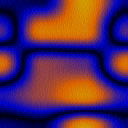
Real-time fly-through of an infinite textured tunnel. Originally a Java applet from 1997. Since modern browsers no longer support Java applets, the original applet code was transpiled to JavaScript/Canvas to make the effect viewable again. The JavaScript version renders in true color (24-bit RGB) instead of the original indexed 8-bit palette.
A polar coordinate lookup table is pre-computed at startup (angle + radius per pixel), turning the expensive atan2/sqrt into a one-time cost.
Each frame only performs additions, bitmasking and a single array lookup per pixel.
A cycling sinus distortion on the radius creates the characteristic wobble effect.
Tunnel effects were a demoscene classic on Atari ST, Amiga and PC — the pre-computed polar table made them fast enough for 68000 and 386/486 hardware, where the inner loop was pure memory reads and bitwise ops.
requestAnimationFrameThe texture is loaded from a hidden <img> tag with id="img1".
Any seamless, power-of-two texture (e.g. 128×128 or 256×256) can be used.
<canvas id="game" width="200" height="200"></canvas>
<img id="img1" src="texture.gif" style="display:none">
<script src="texturetunnel.min.js"></script>| Name | Type | Description | Default |
|---|---|---|---|
colorCycle | boolean | Enable rainbow color cycling | false |
wanderSpeed | float | Speed of automatic center wandering (0 = off) | 1.0 |
wanderRange | float | Wander radius as fraction of canvas size | 0.25 |
Moving the mouse (or touching) over the canvas steers the tunnel center to the cursor position. When the mouse leaves the canvas, the center returns to its automatic wandering pattern.
Originally a Java applet (1997). The original Java applet code was transpiled
to JavaScript/Canvas in 2026 so the effect can run in modern browsers without a Java plugin.
The original used Java’s IndexColorModel with a 256-color palette
and had a texture tiling bug where only half the texture was sampled.
The JavaScript version uses true color and correct seamless tiling.